Monday, December 10, 2012

Democracy and the Ecology of Transportation


John Buell is a columnist for The Progressive Populist and a faculty adjunct at Cochise College. His most recent book is Politics, Religion, and Culture in an Anxious Age.

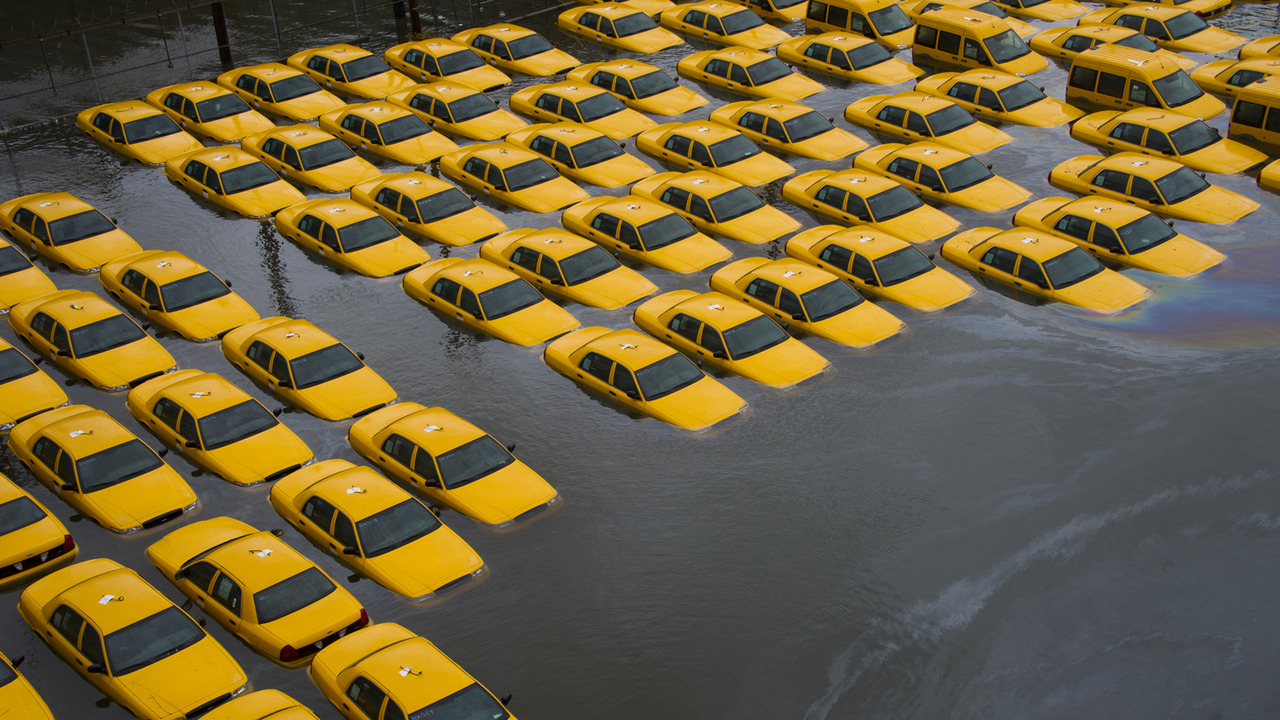
There is no question as to whether New York City and the surrounding coastal communities of the tri-state area will be rebuilt. But will these communities be reconstructed to serve the vast majority of working people or the interests of the economic and cultural elites that have dominated city life? Not surprisingly, those largely responsible for the current crisis are once again eager to take advantage of that crisis. But in the aftermath both of Occupy Wall Street and Sandy, citizens not only in the New York area but also in many urban communities may not be as easily cowed and manipulated as after 9/11. Transit may be an especially vital concern. 

In a recent article in Waging Nonviolence, Yotam Marom reports: "The city government is already thinking about how it is going to spend the enormous sums...that will be poured into redevelopment in the near future... The disaster-capitalist developers are already out there doing everything they can to ensure that they're the ones who get the contracts. The fossil fuel companies, meanwhile, are hoping none of us will put two and two together and hold them rightfully responsible for the climate crisis; they are probably doing all the lobbying they can to make sure the city rebuilds in a way that is as dependent on fossil fuels as before."
taxis

Nonetheless, Sandy still has put the climate science deniers on the defensive. The combination of continuing, deep recession and the storm's vast destruction has opened up possibilities of worker/environmental alliances that might reshape both our economy and urban space.


Sandy raises questions of the role that urban land use and transportation planning can play in reducing the incidence and severity of monster storms and mitigating their effects. More ecologically oriented planning has become a survival necessity.

bloomberg

Forty years ago Andre Gorz pointed out: "The automobile is the paradoxical example of a luxury object that has been devalued by its own spread. But this practical devaluation has not yet been followed by an ideological devaluation. The myth of the pleasure and benefit of the car persists, though if mass transportation were widespread, its superiority would be striking."

flood


The ecological case for making public transit more accessible to more communities is overwhelming. York University environmental studies professor Stefan Kipfer reminds us: "Public mass transportation produces five to 10 per cent of the greenhouse gases emitted by automobile transportation. The latter is responsible for about a quarter of global carbon emissions. In addition, public transit consumes a fraction of the land used by individualized car transportation (roads and parking space consume a third or more of the land in North American urban regions). Not even counting other negative effects of automobilization (congestion, pollution, accidents, road kill, cancer, asthma, obesity, and so on), shifting to transit will markedly reduce the social costs of economic and urban development. It would also make a substantial contribution toward global climate justice."

streetcar

But the case for public transit is not only ecological. A compelling case also must include more than critiques of the auto. Sandy can become an occasion to promote and build modes of mobility, housing and working, shopping and relating to our peers that are more humane and satisfying. The harms and the risks attendant on global climate change are real enough, but too little is made of the human costs of our acquisitive, auto-dependent society or of the kind of satisfactions more sustainable alternatives might offer.


Kipfer argues that capitalism as a world system imposes both mobility and immobility on the poor and working classes. Many poor in the developing world are displaced and forced to migrate to first world cities where they often then find themselves confined to urban ghettoes with only marginal job prospects. Even the working and middle class finds itself trapped in traffic jams and spending larger sums on the auto. Road rage and various forms of scapegoating of these urban minorities grow out of and intensify the travails of our highways.


Are there ways to change this pathological dynamic? One way is to make mass transportation more widespread by making it free. Free mass transit would increase ridership among current users and add some new ones. To those who would complain about the budgetary implications Kipfer points out: "{T}he overall budgetary cost of transit budget expansion can be measured against the typically much higher cost of underwriting car-dominated transportation (road and infrastructure budgets and tax policies which subsidize them). Second, from a macro-economic and social efficiency point of view, public transportation is far less expensive than the existing privatized system."


Kipfer recognizes that mass transit by itself is no panacea for economic injustice or environmental degradation. Transit systems can be designed to bypass poor neighborhoods or to serve only wealthy suburbanites to the exclusion of expanding inner city bus service. Such systems ultimately reinforce suburban sprawl and the car culture and consumption- intense economies. Conversely the expansion of transit systems to formerly underserved areas can become an occasion to remove minorities and gentrify the neighbourhood.

Unfortunately the ongoing economic crisis is being used as an occasion not only to reduce transit subsidies but also to privatize many public systems. Willie Osterwell points out that when transit is privatized the emphasis is upon immediate returns. One consequence is reduction in services and cuts in transit workers wages, thereby blunting support for these systems.


Ultimately the shape of the cities we build both after storms like Sandy and---better yet---to mitigate the effects of such future storms-- will depend on the coalitions that are built. A right wing populist coalition could treat transit and bike lanes and walking paths and the immigrants who use such systems as obstacles to the car. (Remember Atlanta Braves pitcher John Rocker's diatribe against the minorities who use New York City subways.) Or mainstream corporate forces could see a commuter rail as an instrument primarily of suburban real estate development.

metro


Against these visions, Kipfer argues for the social and ecological benefits of broader democratic coalitions: 


To win out against the real, if contradictory pleasures of our car culture, transit has to offer an exciting way of experiencing urban life. The beast so central to capitalism as we know it, 'homo automotivis'... will only die out with a renewed transit culture: being together with others in anonymity and encountering fellow inhabitants not simply through kinship and self-selected sub-cultures but through the unexpected encounters of urban living. Fostering such an exuberant -- curious, open, and generous -- public culture of being 'in solitude without isolation' will require that many of us relearn the capacity to live outside privatized, atomized and sanitized environments. This is not impossible.

A recent survey by the Pembina Institute reveals that most Greater Toronto Area residents would happily trade their cars and bungalows for walking, transit and denser living arrangements if they could afford it. After decades of worsening congestion and 'world-class' commuting delays, Torontonians seem to have become more intolerant of car-led sprawl and more receptive to more open and public forms of urban life. This makes it possible to think of a transit culture beyond the central city spaces where transit is already a fact of life for the majority of inhabitants. If not from personal experience, we know promising elements of living in large cities from movies, literature, and music: the syncopated rhythms of street life and mass transit, the promise of independence from domestic life, the excitement of bustling crowds, the bouts of unexpected camaraderie among strangers.
Such sentiments cannot be assumed. Their coalitions emerge among different ethnicities and faiths and sporadically germinate ever new challenges and visions. Nonetheless, arguably they can be cultivated, and such cultivation is essential to the politics of transit. These sentiments are no longer limited to residents of a highly cosmopolitan city like Toronto. Even the world's most caraholic culture is shifting. Bill McKibben recently pointed to a poll conducted by the Natural Resources Defense Council that "suggests that [public transit] would be popular with the public, 59 percent of whom believe that the U.S. transportation system is 'outdated, unreliable and inefficient.' Americans also want to be less dependent on cars. Today, 55 percent prefer to drive less, but 74 percent say they have no choice, and 58 percent would like to use public transportation more often, but it is not convenient or available from their home or work."


Osterwell wonders: "What would cities look like with bikes, buses and even subways truly run by their citizens? For now, the question is pie-in-the-sky, but public transit truly run by the public and for the public would make cities more equitable, more green and less prone to temperamental whims---of market forces and politicians alike. If we start imagining and building these systems today, we can start building the cities we'd like to see in the future."

party

Ultimately sustainable public transit systems require creating or revitalizing public space and thus democracy itself. A more vibrant democracy can help shape systems that in turn strengthen our democratic commitments.

Share:
Continue Reading →

Monday, December 3, 2012

Fall from the bully pulpit: Rob Ford and the dubious case of neo-liberal "ethics"


Willy Blomme
Johns Hopkins University

On November 26, the mayor of Canada's biggest city was removed from office. A judge ruled that Toronto Mayor Rob Ford had contravened Ontario's Municipal Conflict of Interest Act and imposed the penalty mandated by the legislation: vacating the office (suspending the decision for 14 days to allow for administrative changes). After a collective moment of stunned silence reactions poured out from public figures, commentators and citizens – ranging from the predictably outraged to the gleeful. Elected mayor two years ago, Ford is a polarizing, controversial and gaffe-prone figure. More importantly, he is a bully. And a bully who engages in the dubious ethical grandstanding so popular with the right today that creates an environment toxic to democratic deliberation.

Rob Ford's two years as mayor are rich in controversy, making it hard to see past the screeching headlines to the substantive damage he has done. A greatest hits of Ford follies includes: repeatedly skipping City Council and Executive Committee meetings to coach his high school football team, commandeering two City buses (and kicking off their paying passengers) to transport the players of his team after a rain-soaked game, getting caught behind the wheel of his SUV reading while driving on the highway, declaring that anyone who commits gun violence in Toronto should be deported from the city, calling in top City bureaucrats to ensure that the road in front of his family business was repaved in time for its 50th anniversary celebration, and skipping the mayor's traditional role at the front of Toronto's million-strong pride parade two years in a row because of a family cottage weekend. (Here is a quick summary of Ford's troublesome decade-long record as a city councillor, including attacks on racialized communities, AIDS victims and cyclists.) 

Given this litany of gaffes, controversies and attacks it is somewhat surprising that what brought Ford down is a relatively minor infraction. He was found guilty of a conflict of interest for speaking to and voting on a motion in Council that excused his repayment - recommended by the City's Integrity Commissioner - of $3,150 in donations to his private football charity raised through fundraising letters sent on City letterhead to lobbyists and corporations. As the judge noted in his decision, the incident was made more serious by Ford's "willful blindness" and "stubborn sense of entitlement (concerning his football foundation) and a dismissive and confrontational attitude to the Integrity Commissioner and the Code of Conduct." From the launch of the case the story played out rather comically like a tale of your regular schoolyard bully. First, Ford vehemently denied that there was any conflict of interest (I did nothing wrong!). Then, in his courtroom testimony he admitted that, despite being a Councillor for ten years and Mayor for two, he had never read the Conflict of Interest Act or the Councillor's Code of Conduct (I didn't know!). Once the verdict came down he immediately lashed out, blaming a "left-wing cabal" for orchestrating an attack (It's not my fault!), painting himself as an innocent victim just trying to help kids (I'm the victim here!). Finally, the day after the verdict he apologized for how others took his words, without admitting any wrongdoing (I'm sorry you feel bad.) 


Before his fall Ford adopted the familiar right wing strategy of painting himself as standing up for "the little guy" by ferreting out "waste" wherever he could. Ford was elected by a majority of voters on a populist promise to rid Toronto of its "gravy train." Exactly what this gravy train referred to was conveniently never specified, though allusions to "waste" and "overspending" were often dropped into the same sentences. The gravy train symbol worked in part because it fit well with Ford's infamous stunt during his decade as a Councillor. Every year when the expenditure reports came out Ford would rail against any Councillor who spent a significant portion of the $50,000 budget allotted to the running of his or her office. He invariably pointed to his own annual office expenditures - ranging from $5 to $10 - as the example of a responsible budget. (It should be noted here that Ford is independently wealthy due to a successful family business.) Office budget spending was an example, in his mind, of a waste of tax-payers' money. This is the familiar neo-liberal calculation: spending = waste = unethical.  This simplistic formulation is more than just an attempt to reorient the focus of ethical concerns in politics, it is an attempt to make spending a matter of ethics rather than politics. By making this shift the right preempts the debate about political priorities that is actually behind decisions about government spending.  It also, conveniently, turns attention away from actual unethical practices. Hence Rob Ford's inability to see - or "willful blindness" to - how his conduct in his conflict of interest case was in fact unethical.


Having fashioned their capes of "spending is wrong" these self-proclaimed ethical crusaders feel free to push around all those who stand in their way. Even when that means taking on the defenders of ethics themselves. From the early days of the Ford administration there were reports that City bureaucrats were afraid to speak up for fear of retaliation. Those fears materialized very publicly when Gary Webster, the chief general manager (and 37-year employee) of the Toronto Transit Commission was fired for giving advice - based on his experience and assessment of transit in the city - to Council that differed from the mayor's preferred plan. A few months later it was the City's Ombudsman who was in the hot seat. Ford's ire was raised by Fiona Crean's report accusing his office of a rushed, compromised and interfering selection process in the appointment of citizens to 120 civic boards and agencies (including directing bureaucrats to remove from newspaper advertisements a reference to seeking “diverse” candidates – this in a city whose motto is “Diversity our strength”). For five hours Crean was subjected to vitriolic attacks from Ford's allies after giving her report to Council. More worryingly, when the report was made public Ford's allies mused openly about not renewing her contract and of cutting resources to her office and that of the Integrity Commissioner's.  


This is a pattern of behaviour that closely mirrors that of the Conservative government in Ottawa. Since gaining power in 2006 the Harper government has adopted a series of bully tactics: it fired the chair of the Canada Nuclear Science Commission for her criticism of the government's running of a nuclear facility hours before she was to appear before a parliamentary committee; it barred scientists working for Environment Canada from speaking to the media; it tabled an omnibus budget bill that amended almost 70 different laws in one fell swoop; and it has a second omnibus bill before the House now. Perhaps most worrisome is Harper's cynical use of a once little-known procedural rule (prorogation) that prematurely ends a parliamentary session, killing all the bills on the order paper. He first used it to avoid a censure motion and later to avoid questions about the handling of Afghan prisoners by Canadian soldiers. This highly suspect use of the rule has spread. Ontario Premier Dalton McGuinty used it most recently to shut down the legislature upon his resignation, allowing his party to conduct a leadership race hassle free. Explaining his decision to prorogue McGuinty claimed that he did so in order to allow "discussions with our labour partners and the opposition to occur in an atmosphere that is free of the heightened rancour of politics in the legislature.” In their abuse of this procedural parliamentary tool Harper and McGuinty have effectively told their respective legislatures "don't get too critical or I will shut you down." This abuse has transformed prorogation into a persistent threat - a Damocles sword - hanging over the heads of legislatures across the country. Just like the Ombudsman and Integrity Commissioner bullied by Rob Ford and his allies, and like the nuclear safety commissioner fired by Harper for raising concerns about a potentially dangerous facility, legislatures are being told that if they are too critical or ask too many questions - essentially, if they do their job - they will be made redundant. This is not only bad news for Canada's democratic institutions, but also for the public that relies on revelations made in these bodies to inform broader democratic deliberation.

There is a culture of intimidation taking hold in Canadian politics.  Here's hoping that Rob Ford's removal from office inspires more of us to stand up to the bullies.

Share:
Continue Reading →

Monday, November 19, 2012

Digital Killed the Video Candidate

Davide Panagia
Trent University

In no uncertain terms, this month’s American presidential election signals Barack Obama as the first New Media President. I will quickly concede that this is an odd christening. New Media technology was around in 2008, and indeed prior to that. And we have read and heard a lot about the potentials of political mobilization thanks to the influence of social media technology (think here of Tahrir Square). But what the immediate aftermath of the 2012 Presidential elections secured for our cultural-political zeitgeist, and what contributed to our collective schadenfreude, is the conviction that the numbers were always on Obama’s side, despite what Karl Rove’s gut told him. The question that the Republicans are now asking themselves is how they could have been so wrong in their convictions?

The answer lies in the role of “big data” – something that many American voters had never heard of prior to this elections. Big data is the resource that Nate Silver had at his disposal to give such accurate predictions as he did; it is also the basis for recent developments in humanities research collectively called the “digital humanities” (see the Mapping the Republic of Letters Project here); and it is, as best as I can tell, what will make such companies as Facebook even more astronomically rich than they already are, once Wall Street realizes that what Facebook is selling is not advertising space but massive amounts of information on consumer tendencies generated from our aggregated “hits.”


Obama’s re-election campaign ran a Navy-Seal like digital operation: surgical, tactical, precise, and sophisticated beyond what James Bond’s Q can even imagine. It’s almost as if Obama took a page out of Althusser’s handbook: forgo ideology and go straight to science, so to speak.

Here is how Mike Lynch, former founder and CEO of the UK software company Autonomy, describes the scenario: “Obama’s was not an election won with a clever advertising campaign -- that is too 90’s -- and actually, that is what the Republicans did. This campaign was masterminded by data analysts who left nothing to chance. They revived the virtual campaign centre called mybarackobama.com from the ‘08 election (and thus highlighting the benefits of 'owning' your data), and encouraged supporters to volunteer their personal information, comments, post photos and videos, and donate funds. But this was only the starting point. In a multi-pronged engagement strategy, webmasters used supporters’ content to galvanize others and drive traffic to other campaign sites such as Obama’s Facebook page (33 million “likes”) and YouTube channel (240,000 subscribers and 246 million page views).”

And here is a report from ProPublica.org’s Lois Beckett about recent information released on Obama’s big data tactics.

Big data, data mining, and predictive analytics are the tools of network politics – and they are tools we all volunteer willingly, though usually not knowingly, whenever we click a link or like a post. In doing so, we make what amounts to a charitable donation in the form of micro-data points to massive organizations and global conglomerates who hold property rights to these data-hits; in exactly the way, for instance, that Facebook owns property rights to the pictures of my children when I “share” them on my Facebook page. In fact, it’s not the images they own, but the ones and zeroes that compose the data file which software converts into an image.


 All of this to say what we all already know: that we live in another age of “information overload”, to invoke the Harvard historian, Ann Blair’s helpful phrase. There is just “too much to know” and so, as in other epochs of information overload, we devise strategies and structures for handling information, for organizing it, assessing it, and rendering it valid. The Dewey decimal system was one such invention, as was the transistor radio that converted noise into sound. Writing is, of course, another such technology; as are note taking, highlighting, statistics, and practices of compiling. The number of such activities are infinite, and usually end up multiplying the volume of information rather than rendering it manageable. If I were Malthusian I would say that information has a geometric growth; and if I were Kantian, I would say that information is the best picture of the mathematical sublime.

More to the point, networked humans are information generating creatures. Every click on a keyboard or a mouse, for instance, produces new variations on ones and zeroes that, in turn, generate new information data. As I am not a coder, I have no way of knowing how much information my composing, emailing, and posting of this TCC entry has generated. Suffice it to say that the minimum measure for digital information today is the kilobyte (103 bytes) and that most new computers currently store terabytes (1012 bytes) in their hard drives. Such technological developments, I would suggest, marks a revolution in artificial memory storage that has dramatic consequences for our contemporary networked condition. I will only single out a couple of such consequences.

The first is that code is king. More specifically, source code is king – and code ‘sourcerers’ will inherit the earth. Our world is a world of software: a world of commands and orders relaying signals to go here and there, to execute this task and fulfill that algorithm. As the new media scholar Wendy Chun argues in her book, Programmed Visions, “Code is executable because it embodies the power of the executive, the power to enforce that has traditionally – even within neoliberal logic – been the provenance of government.” (27) This means that in the very logic of network, code is both sovereign and disciplinary master through the algorithmic production of self-regulating rules. (For those with interest in reading more on these issues and developments, I highly recommend Tiziana Terranova’s Network Culture: Politics for the Information Age (PDF) and Jodi Dean’s Blog Theory (PDF).)

Two: Code is indifferent to content. Nate Silver’s algorithmic acumen, that took the accuracy of electoral prediction to alchemical heights, was initially developed as a forecasting system for Major League Baseball called PECOTA (an acronym for Player Empirical Comparison and Optimization Test Algorithm). It can just as easily still be called PECOTA, an acronym for Presidential Empirical Comparison and Optimization Test Algorithm.


What this means is that traditional content-based politics – and our content-based habits of analysis – are being put under substantial pressure by our networked condition. It’s precisely the largesse of big data that makes content almost impossible to handle. Hence the switch, as the new media scholar Lev Manovich notes, from the old new media language of “documents” and “works” and “recordings” (signifying static, content-specific objects) to the big data language of “dynamic software performances,” referring to the interface with real-time dynamic outputs as in the case of video-games or mobile apps. When we do engage these virtual entities, we are not engaging static documents but interactive programs generating infinitely new instances of data. Manovich describes this shift best when he says that “in contrast to paintings, literary works, music scores, films, industrial designs, or buildings, a critic can’t simply consult a single ‘file’ containing all of work’s content.”

This is how digital killed the video candidate. Mitt Romney lost apparently against all Republican odds because Romney was the video candidate: everyone, including myself, was distraught and surprised by Obama’s lackluster performance at the first debate. He just didn’t come out looking good; he didn’t project “good content” ... and Romney did. But Obama’s big data pundits must have persuaded him that he didn’t need to look that good: that the content of his appearance didn’t matter as much as everyone thought it ought to. What did matter was the mosaic generated by big data that offers much more than any singular exit poll, or intuitive hunch, can.


And it’s not that this mosaic is devoid of content. It is filled with content. But that content is mobile, interactive, terabyte content that the video candidate’s more traditional, kilobyte content analysis finds impossible to process.

No doubt, there will be much to celebrate and bemoan in this cultural-political shift. At the very least, I think this election should put pressure on political critics to rethink the criteria of political judgment and assessment with which they (we) have leaned on for so long because one thing is certain: the networked body politic is a much different beast than our conventional understandings of the Leviathan. But then again, rethinking the famous mosaic frontispiece of that equally famous book, maybe not.


Share:
Continue Reading →

Monday, November 12, 2012

On the Coming Challenges


John Buell is a columnist for The Progressive Populist and a faculty adjunct at Cochise College. His most recent book is Politics, Religion, and Culture in an Anxious Age.

President Obama may soon face a three-headed monster. Though a tepid recovery is underway in the United States, unemployment remains high and some of the tools used to promote recovery carry significant risks of their own. Worse still, the specter of a Eurozone bankruptcy haunts the world economy. Finally a Eurozone collapse itself may trigger the worst political crises since the height of the Cold War. On both sides of the Atlantic, political leaders are beholden to investment bankers, who in turn are operating in a predatory fashion.
Matt Taibbi on Goldman Sachs

Here in the US any fiscal policy, even the modest jobs initiative proposed by President Obama in 2011, remains on hold. Worse still, Congress and the President are set to begin negotiations further to trim the deficit in an effort to avert a self-imposed "fiscal cliff."

With fiscal policy paralyzed, all eyes are on the Federal Reserve. Its controversial Quantitative Easing 3 (QE3) includes two elements. First is the promise to keep interest rates low well into any recovery. Secondly, the Fed has committed to buy long term assets, including the infamous collateralized debt obligations, from its member banks. These steps have the endorsement of New York Times and Nobel Laureate Paul Krugman. Krugman has longand quite properlyadvocated expansionary fiscal policy. But absent that approach, he argues that a credible promise of inflation, which erodes the value of savings, will encourage savers to consume and invest.

Reasonable as this suggestion is, it disregards another possibility suggested by several left economists (see for instance comments on the blog Naked Capitalism). These economists include post-Keynesians like Steve Keen, Philip Pilkington, Michael Hudson, and modern monetary theorists Randall Wray and Stephanie Kelton. They argue that investment decisions are not determined merely by interest rates and that unpredictable and volatile expectations play an enormous role in a crisis. Low interest rates and the fear of inflation may stimulate investment. But it may also encourage commodity or foreign currency speculation.

More broadly, Krugman denies the role that investment banks play in creating money and thereby fostering booms and busts. In this regard the signal Fed purchases of junk securities sends to the banks is especially dangerous. It constitutes one further message to banks that their speculative excesses will be backed up by the central bank. In a worst case scenario banks will take the extended low interest environment as an occasion to engage in new commodity speculation and securitization in the confidence that they can get out before any collapse and/or be bailed out in the wake of that collapse.

In Europe, the situation is even more dire. I recently had the pleasure of attending a conference on the Eurozone at Columbia University Law School. Greek economist Yanis Varoufakis was one of the featured speakers. He highlighted the damage that the continent-wide embrace of fiscal austerity is doing to citizens across the Eurozone and Great Britain. Spain and Greece are now experiencing conditions fully comparable to 1929. Even formerly prosperous and well- run businesses cannot find the short- term credit on which most business depends.

In Europe's case a false diagnosis leads to a counterproductive cure. The US media routinely characterize Spain, Italy, Ireland, Greece and Portugal, the so-called PIGS, as just that, governments that have overspent their means. Such accusations are totally wrong in the case of Spain and Ireland, which were both models of fiscal rectitude before their banks blew up. Other than Greece, the remaining states had fiscal problems, but these were manageable. Rather than a matter of public sector profligacy, the Eurozone crisis is anchored in its faulty architecture. Its nations share a common currency but no common fiscal (centralized tax and spending) mechanism.


Some brief background is useful here. From the early fifties the core European states had a common market but no common currency. The Lira, the Deutschmark, the Frank, etc. floated against each other, changing daily in relative value. In practice these floating arrangements provided some protection against "asymmetric shocks," such as a sudden decline in world appetite for Italian wine. In such an event, nations could allow their currencies to devalue and thus become more competitive. Such devaluations were not without pain, especially inflation, and could lead to competitive devaluations by other nations. Nonetheless, devaluations did give damaged economies the prospect of return to prosperity.

In Europe, with the creation of a common currency zone, where a Euro in a Spanish bank was worth just as much as a Euro in German banks, it became easy and attractive for German bankers to invest in houses and commercial real estate in Greece, Ireland, and Spain. Banks made billions. Then a real estate bubble that would make Nevada look like the epitome of prudence burst. Banks became insolvent, lending and economic growth collapsed. Ireland and Spain's government debt burdens were a consequence of government decisions to bail out their profligate private sector banks rather than of spending on ordinary citizens. Nonetheless, these nations had no way to devalue except to wait for a long slow process of unemployment leading to wage declineseven as the core European states strove to control their own "labor costs," thus depressing their demand for foreign goods.

Thus far Spain and Italy have not defaulted on their bonds, but each rescue package has involved one step forward and two back. Europe has enacted a pure fiscal orthodoxy more burdensome than even current US policy. Using a US analogy, Varoufakis imagined what would happen if following the housing bubble collapse, Nevada had been asked to recapitalize its own banks and had been unable to avail itself of unemployment compensation from Washington.

The levels of austerity imposed in Europe have not been seen in any advanced economy since the thirties. The self-inflicted crisis has been used as an occasion for a full- fledged attack on the welfare state. Struggling states are told they receive no assistance unless they meet the demands of the German- run ECB. Austerity is promoted as a means of saving the people from its own excesses, but in fact is intended to save German banks from theirs. And it will fail. As economies shrink, tax receipts do also. Debt grows.

Worse still, the demands on the peripheral European states are sold to the Germans on nationalistic grounds. The Greek and Spanish grasshoppers have lived lives of excess while industrious German ants labor away and sacrifice for a rainy day. Such fairy tales can only feed even more extreme forms of xenophobia. Varoufakis reminds us that the politics of hate and xenophobia thrive amidst pain. In Greece, the neo-fascist Golden Dawn is currently registering 22% in the polls, but even more ominous is the way mainstream parties are embracing some of its demands.

A fractured Eurozone with banks and states defaulting on obligations to each other and surely to US banks, a second banking crisis here just waiting to happen, rising nationalism and authoritarian or even fascist governments in Europe. All this awaits the next administration. 

In this regard, Varoufakis's advice to his European counterparts would apply equally to US elites, especially in light of a fourth great crisis, Sandy, and what it represents: "While designing the Recovery, we better beware: The return to growth should not come at any price. What grows matters. We want growth in sectors that generate good things that humanity needs more of and a deep deflation of the toxic sectors that make life nasty, brutish and shortfrom physical pollutants to real estate bubbles and toxic derivatives. We must aim at the mobilisation of idle savings into medium to long-term investments that serve genuine human needsrather than producing new bubbles for the purpose of dealing with the ill effects of previous bubbles that burst disastrously. None of this will be accomplished by markets caught up in an equilibrium of fear that is reinforced daily by universal austerity."

Share:
Continue Reading →

Monday, November 5, 2012

After Sandy, The Politics of Public Things

Bonnie Honig
  Northwestern University


In response to the contemporary neoliberal impulse to privatize everything and the difficulty, in such a context, of preserving public things and of articulating the importance of public things to democratic life, it is important to think about public things.
A few weeks ago, Sesame Street’s Big Bird became a symbol of this struggle though it was not named as such. We witnessed, after the first US Presidential debate, some discussions and disagreements regarding how much money could be saved by Mitt Romney’s promise, at the start of the debate, to cut government funding to PBS. 
The amount of money involved is relatively small, and most of the budget of PBS is raised already through private fundraising, so commentators see this as one more meaningless cut, or as red meat for the right which wants cuts regardless of their size. The former dismiss the gesture, the latter appreciate it, but both see it as a gesture. But what (else) is in that gesture? Surely something other than money is at issue here for both critics and defenders of Big Bird.
  If there is so much brouhaha over Big Bird, if the attachment to it seems fetishistic or infantile, this may be symptomatic of the fact that it is one of the few public things left in the US.

What is not said, or certainly not enough, is that it is not about the money. It is about completing the privatization and destruction of the public things of American democracy, a project that has been ongoing for over 30 years. To most American conservatives, government itself is only a necessary evil (except on the point where they split: the legislation of virtue or family values) and, these days, even those of its functions that have been historically conceded by conservatives to belong properly to government, like imprisonment, border policing, and military defense or adventurism, are increasingly sold off or subcontracted to private industry. All that is left to government to do is to make the policies whose discretionary implementation these subsidiaries execute. The claim is sometimes that these private companies can do the job better or more efficiently, or that they are better job-creators than the government. (Either way, note, it is about getting the “job done," a phrasing that should strike readers of Hannah Arendt as particularly problematic in a political context.) 
But the real issue here, surely, is a political orientation rooted in a fundamental antipathy to public things and their sometimes magical properties which, not to put too flat a point on it, Big Bird represents. Everybody loves Big Bird! was the refrain after the first Presidential debate. Exactly. And democracy is rooted in common love for such shared objects, or even in contestation of them (which betrays a common love, more than sentimental claims of devotion do). Is it the object that we love (and contest)? Or is it the seemingly a-political but really deeply political publicness it instantiates? 
This is different from the mass consumerist need to all be in love with the same private object – the newest iPhone, say -- and to have one, of which there are millions. That said, this consumer need may well be the ruin, the remnant, of the democratic desire to constellate affectively around shared objects.
The ruin speaks out sometimes, though. For example, after Hurricane Sandy, pay phones, normally treated as part of the city’s ruined landscape, emerged suddenly to become communications life-savers; relics with an afterlife. As Ben Cohen noted, “Natural disasters tend to vindicate the pay phone” which is “mounted high and sometimes behind glass stalls [and so] generally remain serviceable during power outages, even amid flooding.” Focusing on the only problem would-be users now face, coin-overload, however, this journalist misses the real importance of so-called pay phones. They are, as indeed they were once called, public phones, situated on the streets and available to everyone. 
Though not publicly owned (they are now serviced by 13 different local pay phone franchises) they are regulated by New York’s Dept of Information Technology and Telecommunications. Said one new user of the old technology “it’s funny what’s hiding in plain sight…it’s invisible, but when you need it, it’s there.” Surely, that quaint trait of the public telephone stands synechdochally for the quaintness, in our neo-liberal context, of publicness itself. That is, it is not just the technology of the phones that is like a relic from a past time. What is funny, invisible, but hiding in plain sight is the idea of public goods, goods that conjoin people, and are to be shared among various users from all kinds of backgrounds, classes, and social locations. 
At the moment, in the aftermath of Sandy, there is talk about demanding better cell phone towers to secure coverage in emergencies, but this response is rather like the decision to build more roads for cars a century ago, in place of public transportation. There should really be more talk of securing more pay phones and more appreciation of the fact that the ones they have in NYC, that most palimpsest-like of all cities, in fact seem to work. 
The longing for public things may in fact have found expression in this week's return to discussions of climate change. It could just be one more round of emergency politics. But it could be also, or somehow, a subtle promise of collective goods, demanding our attention, offering a site of constellation to those hungry for public things.

Share:
Continue Reading →