Monday, August 13, 2012

A Dark Knight for Entitled Times


Steven Johnston
Neal A. Maxwell Chair in Political Theory, Public Policy, and Public Service, University of Utah


Handicapping presidential elections becomes, every four years, an American pastime. So, I’d like to offer an early prediction. Mitt Romney will defeat Barack Obama in November—not despite his neoliberal extremism which promises an apartheid America, but because of it. I say this given the stunning success of the final installment of Christopher Nolan’s Batman trilogy, which opened July 20th. Not even two weeks old, it has already crossed the $300 million mark.


The Dark Knight Rises is a strange denouement to an otherwise fascinating triptych. The story takes place eight years after Batman has taken the rap for a crime he did not commit, the murder of Gotham’s crusading district attorney, Harvey Dent. Dent had been mounting an effective campaign against crime and corruption, with Batman’s extralegal assistance, of course, until he had to pay a severe personal price for his service. He then turned to crime himself, which Batman and (future police Commissioner) Gordon covered-up by implicating the man in the black cape. In the aftermath of Batman’s foul deed, Gotham is reborn, thanks to the awesome powers contained in the (posthumously named) Dent Act, a law and order bonanza granting near-limitless discretion to the city. Unlike Harvey Dent, Batman is willing to impose and endure sacrifices for Gotham’s greater good. He will play whatever role the city needs. And what it needs, to rally and unify itself, is a scapegoat. A tragic bind informs The Dark Knight, as Batman saves the city by also doing great harm to it, including himself, the latter leading to a life on the run. The new Gotham will be built on a lie and the ruins of a life.


The life also belongs to Bruce Wayne, billionaire, philanthropist, playboy. Stripped of cape and crusading, Wayne retires to his castle a feudal baron and recluse. When Gotham is once again jeopardized, however, Batman sounds the alarm and resurrects himself. He will do whatever is necessary to save Gotham, which, it is clear, he considers his personal domain.


Initially, Batman is no match for his new enemy, Bane. Broken and beaten, Batman suffers external rendition, which cannot stand. As Gotham moves closer to annihilation, Batman finds affective and physical reserves on which he can draw for the rematch. Since Batman is a comic book figure, I suppose it’s fitting that his ability to heal himself takes ludicrous form: he overcomes a serious spinal injury through a primitive kind of traction and lots of sit-ups. It might be tempting to invoke patriotism as the balm that heals, but the film’s conclusion makes it clear that Batman had no intention of making the ultimate sacrifice for Gotham, though he’s happy to let the people think so. He’s living the good life in Italy with his new love. When the legend threatens to become fact, build a statue to the legend. The only people who don’t know about Batman’s legerdemain, of course, are the people themselves. The film makes a mockery of patriotism, which it reduces to pablum served up to gullible citizens who need to believe in something or someone greater than themselves, which means they need, in this case, childish fictions.


The Dark Knight Rises shows contempt for regular people. Batman’s enemies plan to slowly destroy Gotham, with, of all things, the people’s help. They play the class warfare card and the people run amok, throwing the rich out of house and home and onto the streets in terror. Once they have tasted the spoils of war, they act like pigs and despoil their own booty. You can’t let just anyone into the world of the rich and famous, can you now? They won’t know what to do with it. The life of the one percent is for, well, the one percent.


Despite a nuclear threat, moreover, the people stay in their homes cowed. No one takes to the streets in the name of the civic. This is ultimately Batman’s war to win or lose—because it is his city. If The Dark Knight Rises makes a mockery of patriotism, infantilizing it, it also makes a mockery of democracy, demonizing it. This should come as no surprise. When a gang of virtue-obsessed vigilantes first proposed destroying a corrupt Gotham in Batman Begins so that it could rise from its own ashes, Batman, in its defense, pleaded for more time to do the job himself—if with a fewer casualties. Even so, every time Batman swings into action, accompanied by pulsating, deafening music, you can’t help but thrill to the violence about to be inflicted on his enemies. Given the fascist sensibility in play, you should be rooting for mutually assured destruction of Batman and Bane, but the film reaches a part of you that identifies with excessive force and yearns for its unrelenting expression against state-designated enemies.
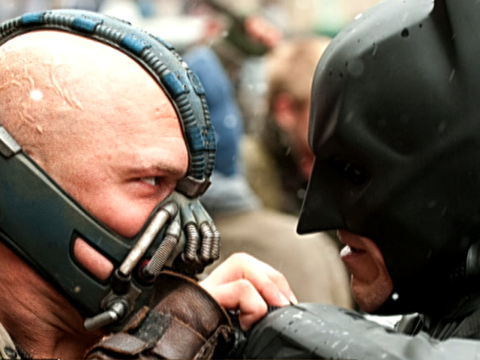

Bruce Wayne—perhaps aided by secret Swiss or offshore accounts—finally abandons Gotham for Europe and a life of ease. Yet with his menacing statue left behind, Batman continues to rule—in absentia. He no longer needs to be present to govern the city. If a false hero such as Harvey Dent can inspire a new regime, imagine what a true hero can do with a little granite. And now that the people understand they cannot be trusted with power or wealth (they abuse one and squander the other), they know their place. Should they forget, Bruce Wayne can return whenever he desires. His economic empire may have been formally destroyed, but he has the connections to rebuild it. The one percent always has options, as Bill Connolly’s recent post nicely demonstrated. In the meantime, Batman has anointed his nominal successor, Robin, to the seat of extralegal power. But what Batman gives he can also take away.  It’s his city and the people live in it according to his rules. The social and economic elite can be trusted to rule the world, largely to their benefit, it goes without saying, and we are to live gratefully in it, especially since these elite cultivate and indulge an aspiration that one day we might actually join them. The Dark Knight would quickly come out of retirement should that remote possibility ever become an actual threat to the order of things. Still, in the United States alone the film is on its way to the half billion dollar mark in ticket sales—by the people. Start practicing now: President Romney, guardian of the regime.
      

Share:
Continue Reading →

Wednesday, August 1, 2012

The Real Entitlement Crisis


William E. Connolly
   Johns Hopkins University


According to the Republican Party, Wall Street, “Morning Joe”, Fox News and every neoliberal financial analyst we live in an Entitlement Society. And it is carrying us into crisis. All the entitlements they want to reform or eliminate are provided by the state. Medicare and Social Security are the biggest villains, with Medicaid hot on their heels. So the critique of the entitlement society goes hand in hand with the demand by neoliberals to divest more and more activities from the state so that the market can handle them in its way. The neoliberal claim, in contrast to both the Keynesian liberals and radical democrats they oppose, is that the more activities folded into the “impersonal” market the more rational the world will be and the less taxes the state will gulp down. You can thus have both tax reduction and deficit reduction according to this fantasy. This story is all too familiar.
But why is the fantasy so persistently pressed even amidst abundant evidence that it is not true? Well, part of the reason is a theme that lurks just below the surface of neoliberal rhetoric. The more that the state safety net is handed over to the private sector the larger the number of constituencies who will be totally dependent on the market; they will be locked into a logic of opposing taxes, identifying with entrepreneurs and corporate elites, resisting market regulation, demonizing the poor, and defunding state activities that cannot be defined as military, crime control, or subsidies for “job creators”. Many moderates and Independents are also tempted by this story, as they struggle to make ends meet and wish they could locate an automatic way to resolve our ills without intervening in a gridlocked political process. Neoliberalism both satisfies market ideologues and plays to many people trying to get through the day without adding close involvement in the political dynamic to their heavy agenda of responsibilities.
The most obvious thing to note about the above “entitlements”, of course, is that each generation pays into these funds and each promises to support the next in turn through its payments. They are funded through a cross-generational social contract that builds trust across the generations. They are not welfare, though Medicaid is an exception.  Neoliberals do not like such programs in part because they want all social trust to be funneled into market processes rather than into cross generational links between citizens.  They also don’t like the fact that these programs work well, setting dangerous counter examples to their chant that the “cumbersome” state can never be successful and efficient. 
Given that background let’s look more deeply into why the word “entitlement” applied to the poor and middle classes is so appealing to the neoliberal Right. Why choose that word as the title of choice? Let’s peel this onion to uncover its rhetorical power.
   Well, on the first layer there is the idea that too many people have come to feel entitled to benefits which they have not earned within the market place. The implication is that even if people pay into these programs they still have not earned a return on their investment by cashing quarterly dividend checks and profiting from the low tax on investment returns.  The mythic idea is that the corporate rich take risks to earn profits while others merely siphon off the largesse of the state. Very few remember to add that the rich can often pass their losses down the line to save themselves, or that the state is formally accountable to the electorate while the market is accountable only to itself.
The word “entitlement”, however, does much more than merely quarantine those who earn their income from jobs and pay into public programs from those who profit from market processes.  It also conceals under the rubric of this shaky private/public split how one constituency works both sides of it to become the most entitled constituency of all.  I refer here, of course, to the rich and the superrich. They demand and receive special entitlements in the shape of a news media that coddles them, huge subsidies from the state for their enterprises, undue deference by those who seek jobs or philanthropy from them, an amazingly low estate tax, tax laws that allow them to pay a lower percentage of their incomes than their employees, and special access to public officials to ensure that their activities are not closely regulated in the public interest. Indeed, as Paul Krugman details in a recent NYT column entitled “Egos and Immortality” this class feels entitled to curtail any criticism of its position, resources and excessiveness. They dismiss it as “class envy” when such charges are brought from any quarter. They confuse envy with indignation. Wall streeters, he says, “are spoiled brats with immense power and wealth at their disposal.” And they are using that wealth to “buy immunity from criticism.”  Let’s say, they feel entitled to put us at risk and to squash our attempts to hold them accountable for doing so. 
We do face an entitlement crisis, then. But it is not the one identified by Fox News and the Neoliberal Right. It is the one concealed by the nomenclature and attacks by the Right. What’s more, as the recent economic meltdown in 2008 demonstrated, these entitlements are not only unjust, they are extremely dangerous. A class entitlement to escape regulation while putting at risk a whole society, and indeed world, is nothing to sneeze at.  And as we have seen most recently, even if a world wide depression is avoided after such a meltdown, its costs and sacrifices gradually trickle down the social ladder until they, too, reach those at the middle and bottom layers of society. So, the rich and the superrich feel entitled to monopolize the largesse when growth occurs and to pass down the costs of their adventurism when the bottom falls out.  That is a hell of a lot of entitlement. That is precisely why so many are so eager to publicize the false version of “the entitlement society” today, within state legislatures controlled by the Republican Party, through Superpacs allowed by the gang of five neoliberals on the Supreme Court, and on the 24 hour News Media.  Reduce the deficit, they chant, by curtailing programs supporting the middle and poor classes. Quietly accept the double-trickle down process. But don’t you dare touch the entitlements of the rich that put everyone else at risk.
The real entitlement crisis also puts democracy at risk, as Steven Johnston has shown in a recent post on TCC. It would take action on numerous fronts to expose, shame and tame the real entitlement class. Media exposes, blog assaults, public protests, electoral victories, teach-ins, new Supreme Court appointees to replace those now governed by neoliberal ideology—all these and more would be needed. The goal would be to galvanize the young and minorities of numerous sorts to take back this culture from the entitlement class.
The stakes are high.   Many leaders of the entitlement class believe that we are ordained to drink this socially toxic cocktail to protect their largesse, subsidies, social risk taking, privileges and expectations of deference. And too many outside the elite who aspire to the same entitlements identify too strongly with them. Some right wing Christians, for instance, celebrate such entitlements, now acting as if God himself has invested economic markets with divine dispensation. And many in the business elite actively support state lotteries, partly to create new business opportunities and also perhaps to build up false hope among the down and out who cannot get good jobs or pay accountants to minimize their taxes. It is worth noting that evangelists who once opposed gambling as much as they did sex out of marriage have more or less dropped their concern about the first activity. 
When the next meltdown occurs many identifying with the entitlement class will be tempted to impose a neofascist response upon those who protest against its irrational leadership and largesse. For, you see, those who are most intensely and totally committed to such actual or aspirational entitlements are apt to go to any lengths to preserve and protect them. You already see signs of this intensity in laws to disenfranchise poor voters, in the eagerness with which pseudo-doubts about Obama’s American birth and Christian faith are embraced, in the way Romney’s base welcomes the bald lies fueling his campaign, in the secrecy by which the corporate right funds Superpacs to weaken unions and support voter suppression,  in the ugly primary campaigns by Bachmann, Gingrich, and Santorum, in the racially fueled intensity of the gun lobby, and in the disconnect between the Supreme Court’s protection of corporate hegemony in the name of freedom and its treatment of regular citizens suspected of crime or its tolerance of voter disenfranchisement.  This is not a Supreme Court that “strictly” interprets the Constitution. It is one that folds a neoliberal, corporate ideology into its interpretation of key statements in the Constitution. 
Where will President Romney, if and when elected, turn as such right wing drives intensify? I recall that a lot of people said during the 2000 election that George W. Bush was a moderate, compassionate Republican.  Don’t worry too much if he is elected, they said. And, besides, a Democratic defeat will force the party to become more progressive. They were correct that the democratic Left needed to become much more active in the micropolitics of churches, schools, families, unions, localities, protests, consumption choices, and cross-state citizen movements. But two horrible, unfunded wars later it turned out that they could not have been more mistaken about the wisdom of handing an election over to the right wing. 
Now we hear that Romney, too, is a moderate playing to an extremist base to win an election. Or, sometimes we hear that he is a hollow, flip flopper who is not too dangerous for that very reason. I believe the latter is true, but this truth makes him an extremely dangerous man. Hollow men, if you scratch them, turn out to be loaded with existential resentment. They resent their own hollowness, and they seek others upon whom to vent that resentment. The young Romney at Cranbrook Boarding School could, for instance, recruit a gang to hold down a teen age boy and cut off his blonde locks, just because that boy’s distinctiveness assaulted Romney’s fragile sense of normality. Don’t believe his bullshit story that nobody in his generation was alert to the issue of sexuality.  I am older and more honest than Romney, and I grew up in southern Michigan too. I once even voted for his daddy for Governor because he opposed the Vietnam War before Democratic officials were prepared to do so. The issue of sexuality was a regular topic of nervous, ill-informed and defensive conversation in locker rooms. And yet nobody I knew took the sort of action Mitt Romney adopted. 
When the going gets tough for them powerful, hollow men revert to repression.  And this hollow man already has “a base” urging him on, one that could soon control both houses of Congress. If you seek to understand the psychology of a President Romney watch The Conformist by Bernardo Bertolucci. That hollow man first joined the fascists in Italy to protect the fragility of his identity and then attacked the fascists as traitors as soon as the Allied victory over Mussolini was complete. He was not merely a flip-flop artist. He was a hollow man.
The real entitlement crisis threatens democracy and economic stability together. 

Share:
Continue Reading →

Tuesday, July 17, 2012

Scorching Weather and Complacent Media


John Buell is a columnist for The Progressive Populist and a faculty adjunct at Cochise College. His most recent book is Politics, Religion, and Culture in an Anxious Age.


Like sports broadcasters citing new homerun records, local forecasters are now excitedly reporting new temperature records. But noxious chemicals have induced these records, like many of the homerun feats. Nonetheless, juiced weather evokes less alarm than inflated homerun totals. If mass media mention climate change at all, it is only to reassure us that no single weather event can be explained by climate change.  The science of climate change, however, casts this claim in a different light. That scienceand why we fail to address its implicationsought to be front and center.


Silence on climate change is strange, given developments within the field. Though some details are disputed, climate scientists have come to near unanimity as to the seriousness of the problem. Moreover most have concluded that a high degree of further warming is irreversible. Typical of their views are comments by Princeton geoscientist Michael Oppenheimer: "The link between [recent] extreme events and the build-up of the greenhouse gases is best represented by the 'loading the dice' analogy"—as the world warms, the likelihood of occurrence (frequency), intensity, and/or geographic extent of many types of extreme events is increasing. The events are individual data points in a broader pattern, akin to pixels on a computer screen. You can't say much from any one pixel, but a picture emerges when you step back and look at the pattern. That said, for a few types of extreme events, particularly heat waves, it is sometimes possible to connect the pixel to the bigger picture more directly. According to computer simulations of climate, the likelihood that [the 2003 European heat wave] would occur was about doubled by the buildup of the greenhouse gases. As statistical techniques for doing such 'fingerprinting' studies as I mention above improves, scientists have become more confident in making such claims, which is to be expected.


Clive Hamilton’s Requiem for a Species is a timely and provocative analysis of the role our culture and political economy play in climate science denial and evasion. The role of money in politics and the willingness of wealthy fossil fuel interests to deploy that money are prominent. But other factors are significant if less often noted. These include inordinate inequality, faith in markets, worship of technology, and outlooks on death and dying.


It is not accidental that the world’s most inegalitarian industrial society is also the most recalcitrant on environmental issues.  Even David Cameron’s and Angela Merkel’s environmental records put Obama to shame. In the US, just as many of the wealthiest citizens believe they can isolate themselves from squalor and crime by living in gated communities, some also feel they can escape extreme weather through their choice of where to live. Milton Mayer, long time senior editor of The Progressive, once quipped: “The rich don’t know how to live, but they know where to live.”


George Bush surveys New Orleans from the sky, September 2005.


How much longer communities gated in a literal or metaphoric sense will be able to escape nature’s tribulations remains to be seen, but many wealthy citizens remain either insensitive to these problems or confident they can evade them. Such lives grow out of and help nurture a sense of entitlement.


New York Times columnist Timothy Egan has captured their hubris and their shock amidst early summer’s unprecedented wild fires: “We plant villas next to sandstone spires called the Garden of the Gods, and McMansions in Virginia stocked with people who have the world at their fingertips. Then, with a clap, a boom and a roar, fire marches through a subdivision on a conveyance of 60 mile an hour winds. A platoon of thunderstorms so loaded with energy it has its own category name - derecho - cuts a swath from east of Chicago to the Atlantic. The pines flame and hiss, shooting sparks on the house next door, a fortress no more. Almost 350 homes burn to the ground, and nearly 5 million people lose all electricity in sweltering heat. Lobbyists and congressmen curse at mute cellphones and sweat through their seersucker. The powerful are powerless.”


Other widely shared cultural beliefs play a role as well. Faith in technology accompanies a faith in free markets, with each belief strengthening the other. That government played a major role in R & D for pharma and in subsidizing the computer and the Internet is conveniently forgotten. Nationalism also reinforces this collective confidence in technology and markets. US power and prestige in the world are attributed to our free markets and our technological acumen. These faiths are in turn strengthened through portrayal of liberal or radical skeptics as wimpy or devious.


For many working and middle class Americans, environmentalists become the new bogeyman. Their concerns and demands are blamed for economic turmoil. Hamilton suggests that they serve as the “other” against whom the current system and its values of hard work and consumption are validated. I would add that the failure of liberals throughout much of the last three decades to deliver stable employment only added to this vulnerability.


Of course, faith in free markets has hardly been without some challenge. Yet as Hamilton points out, for much of the US Left faith in technology, albeit under more state direction, remains supreme. Or environment is regarded as a “distraction” from the real issues of economic power, as though we are the only animals on which nature has no hold.


Hamilton unfortunately includes unnamed “post-modernists” as contributors to climate science denial. These mystery Frenchmen believe: “the truth of modernism is socially constructed and the real truth is always contestable.” Yet rather than contesting all truth, a range of philosophers from Nietzsche to Deleuze have posed their own counter truth, a nature characterized by pluripotentiality and surprises.  Modern climate science can and does provide evidence "though not proof" for such a view and can draw on such an understanding in its model building. Like Hamilton these so-called postmodernists point to the limits of linear causal models and highlight the psychic needs mainstream conceptions of a mechanical, clocklike world serve. Far from undermining environmental activism, the emphasis such so called "postmodernists" as William Connolly place on self-organizing systems in many domains and their complex potentially catastrophic interactions adds urgency to the need for policy intervention on several fronts. In addition, Hamilton’s sensitivity to the ways in which environmentalists are demonized in order to secure the modern consumerist identity could itself be read as reflecting that late Frenchman Derrida’s attunement to the ways the quest for secure identity leads to injustice to difference.


The very perils to which climate science points deepen the political challenge. We have already passed a tipping point. No matter what we do now, our children will live on a more inhospitable planet. This is hard to acknowledge in a land drenched in technological optimism. The temptation to repress and return to business as usual remains strong.   Nonetheless, what we do still matters. Cutting greenhouse emissions dramatically now will mean less severe and rapid climate deterioration. And we can plan, design, and build on a large scale for a world of expected floods, droughts, and heat waves.


Jeremy Brecher has called for an international human preservation movement. Brecher is surely correct in recognizing the need for transnational collaboration. Existing nation states and the materialist/nationalist identities expressed in and through them are a large part of our ecological dilemma. Brecher points out that in the late fifties and sixties activists came together across borders, religions, and ideologies to fight for atmospheric test bans.  Yet such a sense of a common survival interest that can override nationalistic or fundamentalist religious creeds and identities is hardly automatic. The partial successes of the anti-nuclear movement depended on more than shared survival instincts. They also required some lessening of Cold War era ideological and nationalistic rigidities at least among some activists.  These efforts might have achieved more had that process gone further.  


Commentators often say that Americans will never give up their consumer lifestyle. We can buy many different autos for transportation, houses for access to good schools, vacation packages to get away from the grind of daily life. But the consumer lifestyle and the culture that sustains it are not inalterable or invulnerable. We cannot buy public transit, clean air, universal access to good schools or quiet neighborhoods. And as we purchase private goods like cell phones, fancy auto, houses in affluent neighborhoods and braces for our children so they can get ahead our neighbors and co-workers make similar purchases. Each is caught on a treadmill of endless work and consumption, which often ends up being disappointing. It is no wonder that survey research shows that beyond basic comfort, more and more affluence does not increase human happiness. There is an opening on which a more ecological politics premised on expansion of opportunities for qualitative choice might develop.


Such seemingly unrelated issues as immigration and end of life care (voluntary euthanasia) also have a large bearing on our planetary future. As Hamilton recognizes, cultural attitudes to death underlie as well as are intensified by these frightful risks and challenges. Our faith in technology and our sense of ourselves as a special people can be read as compensations for a finitude we cannot bear. Thus ethical/ religious questions must also be in play. Is or must death be in God’s hands? Viewing death as punishment or even as an inadequacy of the human condition to be perpetually resented only intensifies the urge to find compensation is techno wonders and belittling others. (Usually some combination of both.)


A new maturity about both death itself and consumption can become more widespread.  This new sensitivity might help us cope with this more dangerous world we have created. Quality of life may matter more than number of years. There may be more joy in a relatively short life spent in contemplation of nature and the wild than in eight decades of the work/consumption treadmill.  New understandings of nature that are neither mechanistic nor updated forms of medieval teleology may help evoke such sensitivity in many of us.   These portray a nature that amidst its periodic order displays moments and realms of stunning and sometimes terrifying surprises. (See, for instance, Jane Bennett's Vibrant Matter:A Political Ecology of Things.)  Exposure to other cultures and lifestyles, aiding in the survival of our neighbors and our families can convey meaning and satisfaction. Concepts of economic “growth” that emphasize environmental quality and increased leisure to develop new interests and sensibilities are keys to this transformation. As Juliet Schor and Benjamin Hunnicutt have emphasized, such concerns are hardly un-American. They are a forgotten part of our labor history and a continuing goal of many downshifters in both urban and rural settings. Broadening the opportunity for such life style choices should be a central environmental goal. 


Movements for international survival often depend on efforts to reduce the psychological, economic, and even religious pressures to secure collective and individual identity by demonizing those who differ in religions, ethnicity, or ways of life. Cultivating a capacity latent in many to appreciate a world of growing diversity in religions, languages and backgrounds, family structure, sexual orientation, music, dress, food preferences will be crucial if we are to survive.


In this regard, the politics of immigration is itself a central environmental issue. The Pentagon is preparing for war against the immigrants sure to be displaced by floods and draughts. Environmental and social justice advocates need to prepare now for a different future by collaborating across borders to provide subsistence for all in developing nations while slowing the mindless and self-defeating growth compulsions in affluent societies. In the process ideally community amidst those who hold different religions, histories, and ethnicities can be achieved and validate itself.
Here in the US activists can demand that our vast military establishment be reprogrammed to provide disaster relief so that, as one of the Navy’s ads says, it can truly become a global force for good.

Share:
Continue Reading →

Tuesday, July 10, 2012

America, Democracy, Elections


Steven Johnston
Neal A. Maxwell Chair in Political Theory, Public Policy, and Public Service, University of Utah

America’s national elections in the fall promise to be expensive and ugly. Expensive because a hyper-activist conservative Supreme Court majority opened the monetary floodgates in Citizens United v. Federal Elections Commission; ugly because the Republican party thinks it is the one and only political entity to rule the United States legitimately. This is one of many reasons it has sought to destroy the presidency of Barack Obama from the day he assumed office and will spare no expense to finish the job over the next four months.


For many citizens, the elections don’t amount to much. The differences between the parties, from one angle of vision, are slight. Each bears responsibility for the neo-depression which continues to inflict awesome suffering on tens of millions of Americans and each remains beholden to Wall Street bankers and financiers. One party would let neo-liberal capitalism run completely amok; the other would moderate it around the edges. Obama’s economic team (Timothy Geithner and Company) champions the very philosophies that led to disaster. As for national security affairs, Obama has extended and enhanced the executive self-aggrandizement practiced by the Bush-Cheney Gang, evidenced most notably, perhaps, in Obama’s claim that the president can play prosecutor, judge, and jury as he orders the assassinations of American citizens while waging personally the so-called war on terror.  Obama has also one-upped Bush-Cheney with unrivaled efforts to target and imprison those who leak, a valuable democratic act, details of government malfeasance and criminal conduct. The hope that Obama represented has come largely to naught. If people don’t feel betrayed, perhaps especially the much coveted American youth, they feel a profound sense of disappointment. Obama’s been a presidential loser.


For many citizens, on the other hand, significant differences between the parties remain—regarding gays, women, reproductive freedom, the environment, religious tolerance, and immigration, to name but a handful of issues. Despite Obama’s abysmal performance as president, a combination of foreign arrogance and bellicosity and domestic foolishness and passivity, a second term would be preferable to a manifest political hack such as Romney, who, when he’s not lying about Obama’s record, exhorts policies (tax cuts, deregulation) that promise more of the same economic destruction and radical redistribution of wealth the GOP has perpetrated for decades. A Romney presidency would do nothing but make matters worse—unless you belong to the same privileged world of Romney. His is a vision of the one-tenth of one percent for the one-tenth of one percent.


There might be another way to think about the election, national politics, and the economy, namely, in terms of democracy’s future. It’s not that the United States can claim to be much of a democracy these days no matter your party affiliation; it’s that the Republican Party envisions an America in which democracy is effectively eliminated and power is privatized. To better service its financial and corporate overlords, it seeks permanent one-party rule, which will further weaken electoral accountability, and give free rein to the fiction of an impersonal market that can only be harmed by state regulation but in reality relies on a great deal of state support to function. This GOP fantasy has been kept alive and nourished by Obama’s pathetic performance.


The ambition of one-party rule lies behind the GOP’s historic abuse of the filibuster, which converts majority rule into effective minority governance by blocking Senate action on legislation; the ambition of one-party rule lies behind the GOP’s multi-state effort to purge the electoral roles of legally registered voters (young, poor, ethnic) who might favor the Democrats in the name of a concern for widespread fraud that does not exist; the ambition of one-party rule lies behind the GOP campaign to destroy public sector unions in the name of fiscal responsibility while the party continues to push for tax cuts for the wealthiest of Americans; this is but a prelude to planned assaults on private sector unions, with both entities assumed to be Democratic supporters; crush the unions, kill the Democratic Party; the ambition of one-party rule lies behind GOP redistricting efforts following the 2010 census to ensure their electoral success prior to any actual election; the ambition of one-party rule lies behind the blatantly partisan Supreme Court decision in Citizens United, which threatens to render moot the always precarious notion of competitive or meaningful elections on behalf of the GOP; it even lies behind John Roberts probable change of mind in the health care decision, a brilliant tactical calculation (given the rapidly deteriorating respect in which the Court is held) to sacrifice a short-term goal better to guarantee long-term political victory.


It’s not that America’s democracy doesn’t routinely find itself, to some degree, under pressure, even downright assault. The “war on terror,” for example, like so many wars before it, has been accompanied by a retrenchment of various political rights, assembly, free speech, and habeas corpus among them. It’s that the Republican Party openly seeks to defeat, marginalize, silence, and ultimately destroy its political enemies so that it can rule (rightly, of course) untrammeled, indefinitely. In this context, it could be argued that citizens have an obligation to vote against the party of their choice, if that party is the Republican Party, because of a greater obligation they have to American democracy.


It’s not enough for Republicans to see their values and interests triumphant at the ballot box; they believe that their values and interests are one with America itself—properly articulated and understood, of course. It doesn’t matter that the people themselves would—do—disagree. Those who disagree are wrong at best, deviant and dangerous at worst. The Republicans have shown that they are ready, willing, and eager to inflict enormous damage on the country to see their one-world vision realized. Hence their opposition to meaningful economic stimulus to put people back to work and help balance the budget despite years of depression; hence their refusal to provide aid to state and local governments, despite record low interest rates, because it would have lowered unemployment rates and bolstered the gains in the private sector; hence their opposition to restoring tax rates to the Clinton era to help balance the budget despite the fiscal cataclysm they say awaits us; hence their opposition to health care insurance for tens of millions of Americans without it and a penalty for free riders, which would also contribute to fiscal responsibility; hence their opposition to even minimal regulatory action to prevent a restoration of the economic practices the damage from which the country still suffers, as J.P. Morgan reminds us; hence their opposition to consumer protection reform that might secure home buyers against destructive mortgages and put a dent in the profit margins of big banks that charge customers predatory interest rates for credit cards and outrageous fees for everyday transactions.


The Republican economic and political vision is incompatible with anything but a pretense of democracy. Democracy is not only unnecessary to this vision; it’s a threat to it. Is it any wonder that American police, taking their marching orders on behalf of private property and “public safety,” after a period of indulgence, acted swiftly and decisively to contain, control, and finally remove the Occupy Wall Street movement from city streets and public view? With democracy an increasingly endangered species and any kind of economic security increasingly beyond reach for most Americans, much more than one election may be on the line in the fall. The nature and future direction of the American economy—and thus the life prospects of the 99.9% percent—are at stake; the distribution of power and wealth both public and private are at stake; America’s democratic future may thus be at stake as well.

Share:
Continue Reading →

Thursday, June 28, 2012

Pounds of Flesh: Mad Men and Greek Austerity


Char Roone Miller
George Mason University


The black silhouette of a well-dressed man falls through the opening credits of Mad Men, cascading through a cityscape displaying advertisements for the program's world of desire: cigarettes, booze, and women.  As if it lacks even a pound of flesh, the silhouette lightly lands on a couch facing, like the viewer, the television and the products it advertises. Don Draper, the lead character, an advertising executive exceptionally skilled at selling fantasy, occupies the position of male desire that many characters in the program wish they could occupy, a perspective from which all the objects of his desire are easily attainable.  Like the silhouette in the opening shot, Draper is mostly a shadow; the demands of family, friends, and his own body scarcely register.  Nothing he desires costs him very much, yet, no one, it often appears, could ask for anything more. 


(Note: this post contains Mad Men season 5 spoilers - ed.)


Draper embodies an inhuman lightness concerning human problems and responsibilities; he cheats on his wife, neglects his children, smokes continually, receives awards for the work of other people, drinks Old Fashions throughout the day, and denies knowing his brother. Rarely do commitments and promises weigh very heavily on this character. He remains the physical embodiment of the fantasy products he so skillfully sells.


Behind the office doors at Sterling Cooper Draper Pryce, doubts about this way of life and the costs of doing business pile up.  Set in a center of American capitalism, Madison Avenue in New York City, Mad Men consistently portrays the lack of satisfaction faced by the Don Draper’s of the world. Even Goldman, Sachs, the show seems to promise, can’t sleep at night.  Heavy casualties pile up in the wake of these very successful business people; the sacrifice of family, friends, and colleagues so that people like Draper can make and remake themselves in the interest of making money. 


In the penultimate episode of this season Draper confronts a partner’s appropriation of money from the agency.  Lane Pryce, a junior partner confronted with large bills, forged Draper’s signature on what he thought would be an early Christmas bonus. Pryce took the money in order to maintain family obligations; responsibilities generally neglected by Draper.  The partners, however, give up their bonuses, leaving Pryce holding $7,500 in fraudulently appropriated funds. This crime could have played like so many others on the show, the kind of thing that white straight men easily forgive one another. When Draper discovers the fraud he fires Pryce, not so much for the money as for a loss of trust.  The issue, as with many accounts of the current economic crisis—from American mortgages to Greek sovereign debt—isn’t the money, but rather some perverse demand for trust.  Bankers in Greece, for example, only stand to have their levels of profit lowered by forgiving and restructuring debt; they are not in danger of actually losing money. Draper and the firm will be fine; in fact Draper offers to cover the debt for Price as he asks for his resignation. In the final episode the firm begins to make so much money the partners don’t know what to do with it all.  Just as Draper, flush with enough wealth that he never has to worry about such things, fails to understand the monetary pressure on Pryce, banks and corporations demand trust from workers in an uneven exchange that treats the worker’s demands for money and power as a morally suspect type of selfishness. Pryce, according to Draper, broke that trust and must pay the price. 


Currently, European and American banks demand that Greece pay a similar price. Money piles up in Greek, German, and American banks, even as the extraction of that money costs so many people in Greece so much: unemployment at 20%, a health care system cut by 25%thousands dropped from disability support, and major sources of public revenue sold to private companies. One symbol of the price of austerity is the 22% increase in suicide since 2009including a 77-year-old retiree who shouted “I don’t want to leave debts to my children,” just before pulling the trigger in front of the Parliament building in Athens


In Mad Men’s first season, viewers learned that Don Draper was an identity assumed by Dick Whitman, when the real Draper was killed next to him in the Korean War.  Draper is long dead; Whitman just acts like him. In effect, every time Whitman claims to be Draper, it’s a crime mirrored to a minor degree by Pryce’s forged check. The position that Draper occupies in order to condemn Pryce’s crime was made possible by a much larger but essentially similar crime.  In the case of Greece the debt that Greeks are being forced to pay was produced through, in many cases, criminal financial exploitation. Goldman Sachs, for example, helped Athens hide its debt by hiding loans as currency trades and by setting up financial arrangements to take over the profits from the airport of Athens. While this may have been criminal the demand for payment still weighs heavy. The ethical demands of money and capital take on a reality lacking in other social relationships (especially for the Draper’s out there). Money’s demands are high for Pryce: the body falling through space in this episode has more weight than a mere shadow; the weight of a hanging body, the weight of Pryce hanging himself behind his office door.


The dapper Draper resembles in style and privilege Christine Lagarde, the managing director of IMF, who the Guardian recently described as elegantly serene, even as the fiscal demands she forces on Greece inelegantly fractures Greek serenity. Ignoring the damage and violence that austerity inflicts on the bodies of living Greeks, she advocates for cuts in education of Greek children, cuts in medical support for the old, and the privatization of public resources. Sounding like Draper’s response to Pryce, she points out the ways that ethics demands that Greeks pay their debts and that money be treated as the preeminent marker of fairness. Debts (to banks) must be paid. “Do you know what? As far as Athens is concerned, I also think about all those people who are trying to escape tax all the time. All these people in Greece who are trying to escape tax.” German Prime Minister Merkel, The Wall Street Journal reported, also asserted the ethical status of paying debt at the cost of great suffering. “It is more important that the new (Greek) government stick to the commitments that Greece has made to the international community and its partners in the European Union.” Forbes Magazine called the renegotiation of the debt by the Greeks 'disgraceful.' “Greece committed a grave injustice,” Richard Salsman argues. “Contrary to convention, morals and money go hand-in-hand.  The Latin root of ‘credit’ is trust.”


Christine Lagarde
The camera's attention to Pryce's dead body does more than symbolize the hypocrisy of the banks and the human costs of financial demands. The very sight of the bloated body provokes a visceral response to the abstracted violence of money and forces a confrontation with the values and flesh excluded from monetary systems of value. Pryce's dead body, moreover, like the sovereign’s material body, confronts the viewer with the equality and immanence of animal flesh.  


The financial crisis is about money but it’s never really about money. It’s about the trust, faith, and belief that people put into money. It is about the production of value in the human body. Gilles Deleuze writes in Francis Bacon: The Logic of Sensation about novelist K. P. Moritz’s description of the execution of criminals and the affect of their meat: “the horror of sacrifice he feels when he witnesses the execution of four men, . . . . ‘thrown on the wheel’ or over the balustrade; his certainty that in some strange way this event concerns all of us, that this discarded meat is we ourselves, and that the spectator is already in the spectacle, a ‘mass of ambulating flesh’; hence his living idea that even animals are part of humanity, that we are all criminals, we are all cattle . . . . This is not an arrangement of man and beast, nor a resemblance; it is a deep identity, a zone of indiscernibility more profound than any sentimental identification: the man who suffers is a beast, the beast that suffers is a man.” Pryce’s flesh in Mad Men makes visual an affective response to the abstract suffering produced not by torture on the wheel in the name of a political sovereign but by the costs of money, credit, and debt to notions of popular sovereignty and equality. The “we” that is concerned here is a “we” made flesh in the body through which money circulates.


Even though it invites a response to the world in abstract, non-sensual, and immaterial terms, money is not an escape from life.  Money moves in relation to life and bodies, establishing the value and meaning of matter.  Money is one of the factors involved in our affective response to the universe, effecting how we see, what we see, and the meaning of those physical responses.  Money receives its value in relation to flesh even as flesh, weighed in pounds or kilograms, priced in dollars, euros, yen, and pounds, receives its value in relation to money.


I know cooler heads should prevail, but am I the only one who wants to see this?


Share:
Continue Reading →